
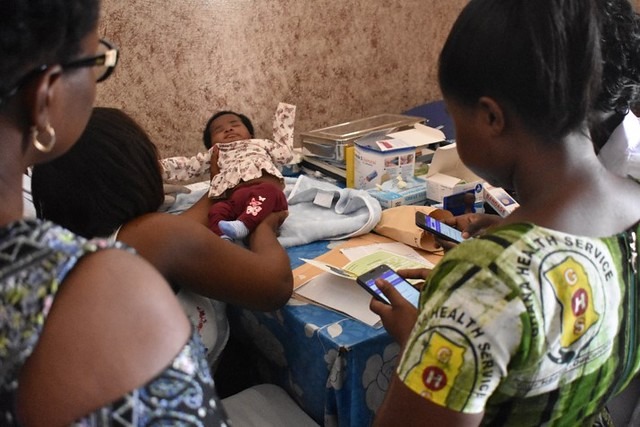
In Guinea, malaria remains the leading cause of illness and mortality, particularly for children under five. To address this, the National Malaria Control Program (PNLP), in partnership with CRS, RTI International, and the Ministry of Health, executed the 2025 Long-Lasting Insecticidal Net (MILDA/LLIN) distribution campaign. The primary hurdle was not just the supply of nets, but the logistical accountability required to reach millions of households across remote regions.
| Campaign Impact by the Numbers By shifting from paper to a digital workflow, the campaign achieved a level of operational clarity that was previously impossible at this scale: 18 Million Individuals: Recorded and reached through the digitized campaign. 8 Million Mosquito Nets: Distributed with verifiable tracking. 2.8 Million Households: Digitally registered to ensure accurate allocation. 22 Million Forms: Submitted via CommCare, creating a complete digital audit trail. 9,000 Mobile Users: Community agents and supervisors coordinated through a single platform. 2,264 Distribution Sites: Monitored in near real-time across the country. |
The Challenge: The Operational Blind Spots of Paper
Large-scale public health campaigns are traditionally high-risk due to a lack of visibility. Relying on paper-based registration and manual reporting typically leads to weeks of “data lag,” where distribution gaps or stock imbalances aren’t discovered until the campaign is over.
In Guinea, the coordination of 9,000 workers across thousands of sites meant that paper systems couldn’t provide the real-time insights needed to manage stock levels or verify that every registered household actually received its allocation.
The Solution: Closing the Loop from Registration to Distribution
The campaign replaced fragmented paper processes with a unified digital workflow in CommCare. This enabled the PNLP to “close the loop” on the campaign lifecycle:
- Enumeration: Agents registered households digitally, establishing a verified baseline for net requirements.
- Distribution: Agents used the same platform to record deliveries and manage site-level stock, ensuring that distribution matched the registered need.
- Offline Execution: Because the platform was designed for low-connectivity environments, frontline teams maintained full functionality in remote areas, syncing data once they reached a signal.
Technical Integration: Turning Field Data into National Insights
A critical requirement for the Ministry of Health was that this campaign didn’t exist in a data silo. The digital workflow was designed for high interoperability:
- DHIS2 Integration: Household-level data was synchronized with Guinea’s national health reporting system.
- Real-Time Dashboards: Using Power BI, supervisors were able to access data-driven insights multiple times per day. This allowed them to identify regions with low coverage or stock shortages while the campaign was still active, enabling immediate course correction.
Conclusion: A Blueprint for Accountable Scale
The Guinea MILDA campaign demonstrates that digital tools do more than just “collect data”, they provide the operational control necessary to manage national-level interventions. By eliminating the lag of paper systems, the Ministry of Health and its partners improved reporting speed and data quality, ensuring that 8 million mosquito nets reached the families who needed them most.


