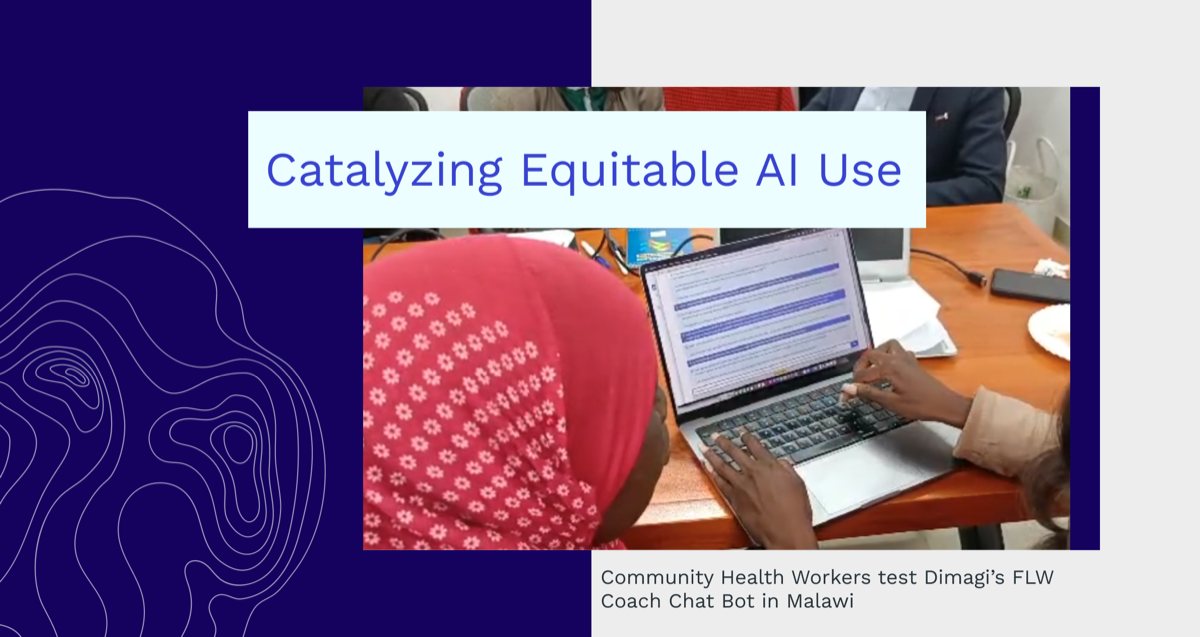
Frontline health workers play a critical role in expanding access to care in low- and middle-income countries, yet many programs face real constraints around training, supervision, and coaching. Recent advances in large language models offer a chance to build interactive, personalized tools that shift coaching from static to adaptive. Here are early learnings from CATSCoach, an AI coach built for frontline workers in Zimbabwe.
Designing CATSCoach: AI-powered mentorship
Dimagi and Zvandiri, with funding from the Endless Network, are designing and testing CATSCoach, an LLM-powered chatbot that provides supportive supervision to Community Adolescent Treatment Supporters (CATS), young people aged 18 to 24 who provide adherence counseling and psychosocial support to children and adolescents living with HIV.
CATSCoach is built on Dimagi’s Open Chat Studio, which lets organizations choose between LLMs, customize chatbots, add safety guardrails, and deploy on platforms like WhatsApp, Telegram, and Facebook Messenger, helping CATS practice difficult conversations, reinforce training, and get immediate feedback.
How CATSCoach engages users
- Adaptive learning pathways: using the EQUIP framework, it adjusts exercise complexity to each user’s skill level.
- Role-play scenarios: realistic client situations covering stigma, disclosure, adherence, and mental health, practiced in a safe environment.
- Quizzes and decision-based learning: interactive quizzes and choose-your-own-adventure exercises build real-world decision-making skills.
- Multilingual support: tested in English, Shona, and Ndebele.
What we’ve learned so far
We tested an early version of CATSCoach on WhatsApp with a group of 40+ CATS in Zimbabwe to understand its usability and effectiveness. The chatbot was well received, with users appreciating its human-like interactions and practical feedback.
Positive feedback
- Engaging and realistic interactions: users found the chatbot’s role-play scenarios useful for developing communication skills.
- Encouraging and confidence-building: CATS appreciated the chatbot’s feedback.
- Helpful in knowledge-building: the chatbot provided structured guidance.
“This app has been a game-changer for me! The counseling guides, quizzes, and interactive scenarios have helped me develop valuable skills to support myself and others.”
CATSCoach participant, Zimbabwe
“The chatbot is good as it asked me some questions and I responded; I was immediately corrected where I had missed correct answers.”
CATSCoach participant, Zimbabwe
“For me it’s perfect, it helped me know how to approach some clients. This was on activity 2: Role play of Nancy, who was having trouble with her caregiver. Chat bot acted as Nancy and I acted as Nancy’s caregiver.”
CATSCoach participant, Zimbabwe
Challenges and areas for improvement
- Identifying a user’s level of proficiency and adapting accordingly: a key challenge was ensuring the chatbot could accurately assess user proficiency and adjust its responses accordingly. Despite the EQUIP framework defining four proficiency levels for each skill, all users were categorized as Level 3, regardless of their varied responses. Refining the chatbot’s ability to evaluate user competency and provide more personalized training will be a top priority.
- Making feedback more concise: many CATS reported that the chatbot’s responses were too long, making it difficult to absorb key information. “The paragraphs are too long, and you end up getting lost.”
- Ensuring responses are aligned to user input: some participants noted that the chatbot occasionally changed topics mid-conversation. “It asked about my client’s emotional barrier but then started asking unrelated questions about home and medication.”
- Refining translations in Shona and Ndebele: users reported that some phrases in Ndebele were unclear. Some terms borrowed from Zulu caused confusion, such as ‘amakhasimende’ (clients), which is not commonly used in Ndebele. “I chose Ndebele, but it is not the usual Ndebele I know as I didn’t know some words.”
- Improving scenario relevance: some scenarios, such as those involving musicians traveling, did not reflect the realities of the CATS’ clients. One participant suggested, “Is it possible to choose the theme we want to tackle?”
What’s next
We’re refining CATSCoach to map proficiency more accurately, deliver more adaptive exercises, and track individual progress over time. In the coming months, Zvandiri and Dimagi will test the updated tool with 100 CATS workers in Zimbabwe, with support from the Endless Network.
Exploring AI for frontline work?
Learn more about Open Chat Studio, or reach out to talk through your use case.
Email the OCS team